Storey's in the Dirt

Regenerative Farming & Food Sovereignty

Garden’s Hidden Treasure – Storing Tubers.

Garden’s Hidden Treasure – Storing Tubers.

by Teri Storey3 min read
Vegetable Gardening

Garden Week Twenty-Six 10/23/2018 ### Garden’s Hidden Treasure – Storing Tubers. Recently, I was visiting with a friend and local musician, Duane McIver. We were talking about the article and how I had recently learned that peonies need to be thinned every 3-5 years. Wouldn’t you know it, he had s...

Share:

Garden Week Twenty-Six 10/23/2018

Garden’s Hidden Treasure – Storing Tubers.

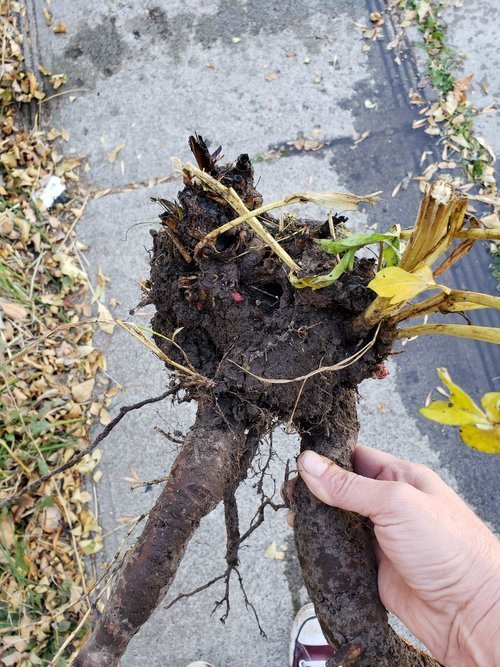
Recently, I was visiting with a friend and local musician, Duane McIver. We were talking about the article and how I had recently learned that peonies need to be thinned every 3-5 years. Wouldn’t you know it, he had some peonies which hadn’t been thinned for many years. Thanks to Duane for letting me thin the peonies and get these great photos!

Several weeks ago, we learned about Bulbs, Corms, Tubers or Rhizomes. If you recall, we learned that peonies are among the Tuber Perennials. The tubers are usually short and thick storage stems comprised of starch-storing tissue with a leathery skin and eyes or growth nodes.

In the fall the Peony stems are cut back to a length of 3-4 inches. It is ok if this was weeks ago. When digging up the Peony tubers, watch for the Heart and follow out the stem to find the length of the tuber. Start 6-12 inches from the main stem area and work your way in. Once the ground is removed, you can life the heart, tubers and roots. Before setting up your work station, the Peony tubers should be sprayed free of dirt and debri and left to dry 12-24 hours.

One the tubers have had time to stiffen, this will limit accidental breakage. Before working on the tubers, it’s important to clean and sanitize your tools. This will prevent the spread of disease and fungus. Make sure your favorite working location it prepped. This may include a prepared a garbage bag for debris, and a clean dry location for the plants once cleaned.

Remove any remaining dirt, and inspect for soft or rotted spots, porous, diseased or dead parts and remove. Don’t be afraid to cut or scrape these areas away. Make sure you throw these away. Do not keep or compost any Rhizomes which are diseased. A good Rhizomes for storage will have, roots as well as stem.

Not every Rhizome will flower next year. Keep the largest of these for next year’s flowers. If you keep the smaller of these, next year you may consider planting them where they can continue to grow for the following year

Once they are all clean, place on a rack or table, in a warm location with good air circulation, where they can dry for a couple of days. They will form a thick layer, kind of like leather. This will allow the plants to store without rotting over the winter and is known as curing.

Once dry, store in a box, or paper bag, by creating layers with straw, sand, newspaper, wood chips, or preferred medium. Be sure to label each container with the species and color so you don’t lose anything. Periodically, check on the rhizomes. Remove any which become soft, so that fungus does not spread.

Enjoy building your Iris Rhizome Treasure Chest!

Happy Gardening!

Part of the 2018 Garden Guide Series

A 25-part series

Where to Go Next

📖Next Start Here

growing Potatoes

## An Easy Soil Mix, Spacing, and Growing Tips There’s nothing quite like homegrown potatoes. Whether you’re after buttery Yukon Golds, deep purple fingerlings, or classic Russets, growing them in **10-gallon grow bags** is a simple and rewarding way to produce fresh spuds without needing a big gar...

Vegetable GardeningVegetable Gardening
Read more →
🔍Dig Deeper

Garden’s Hidden Treasure – Storing Rhizomes.

Garden Week Twenty-Five 10/2/2018 ### Garden’s Hidden Treasure – Storing Rhizomes. Last time we learned about Bulbs, Corms, Tubers or Rhizomes. Today I want to talk about storing Iris Rhizomes for the winter. If you recall, Rhizomes are underground stems, which grow horizontally are capable of pro...

Vegetable Gardening
Read more →
🌱Related Content

Garden's Hidden Treasure

Garden Week Twenty-Four 10/2/2018 ### Garden’s Hidden Treasure So, all these years, I have been referring to Tulips, Daffodils, Crocus, Ginger, Horseradish, Garlic and many other plants as bulbs and tubers. Turns out, there is more to the story. Some bulbs are actually Corms. Some Tubers are actu...

Vegetable Gardening
Read more →