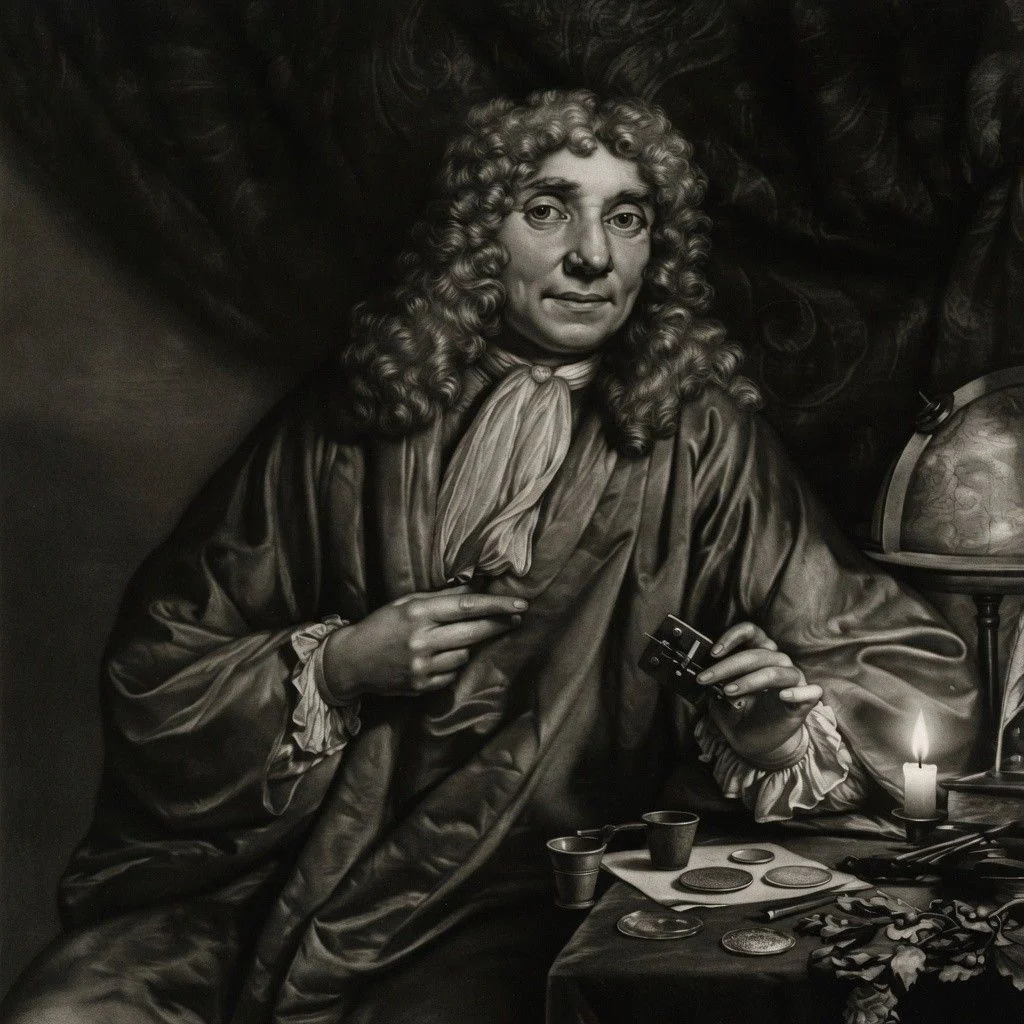
The New Eye: Leeuwenhoek and the World No One Had Seen
The New Eye: Leeuwenhoek and the World No One Had Seen Before 1670, the biological world ended at the edge of what the eye could see. Soil was dirt....
Before 1670, the biological world ended at the edge of what the eye could see.
Soil was dirt. Water was water. Decay was a mystery. The invisible processes that drove fermentation, disease, decomposition, and soil fertility had no names because they had no faces.
Then a draper in Delft ground a lens.
Who Leeuwenhoek Was
Antonie van Leeuwenhoek was not a scientist by training.
He was a cloth merchant in Delft, in what is now the Netherlands. He had no university education. He read no Latin — the language of science in his era. He worked in a shop.
What he had was curiosity and extraordinary manual skill.
He had learned to use magnifying lenses to examine the quality of cloth. He began grinding his own lenses — not with the techniques of others, but with methods he developed himself, largely in secret. His lenses achieved magnifications that...
Level 2 Content
This post continues with Level 2 content.
The rest of this piece is available to subscribers. It continues the series with deeper application, practical frameworks, and seasonal context.
Level 2 posts include longer research, field-tested guidance on KNF and regenerative methods, and systems thinking that connects food, land, energy, and local economies.
Still Cultivating: Hunter-Gatherers and the Knowledge That Never Left
Robert Hooke and the Cell: When Plants Revealed Their Structure
Premium content